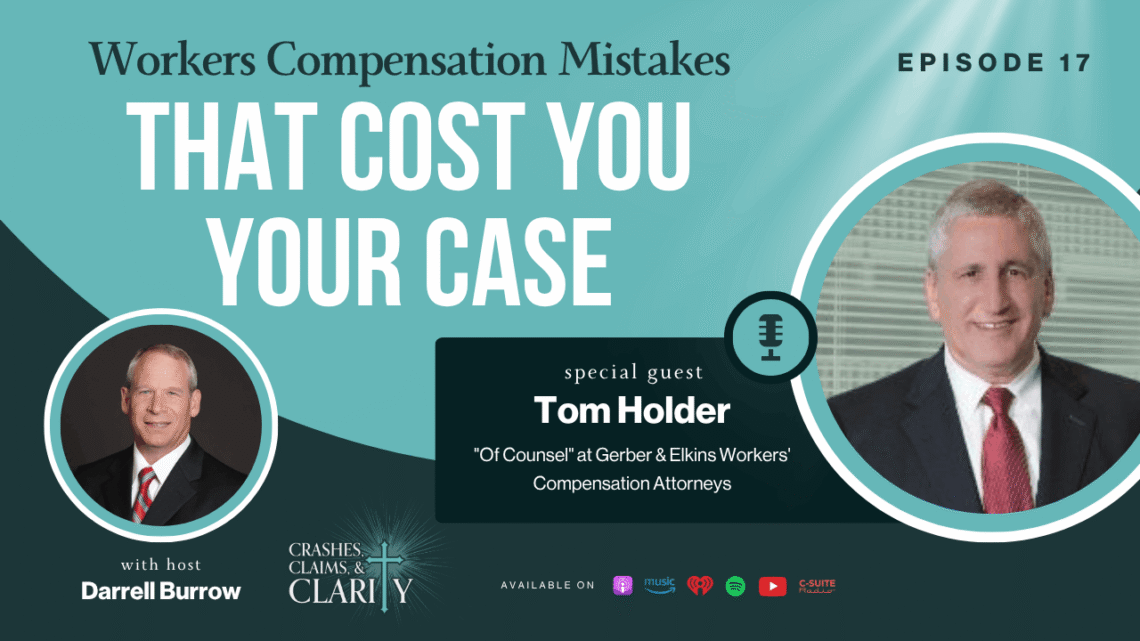
As a Duluth, GA back injury lawyer, Darrell Burrow knows that a workplace injury can create immediate uncertainty for injured employees and their families. In many cases, the actions taken during the first few days after an accident can have a significant impact on access to medical treatment, wage benefits, and the overall claims process. In this episode of Crashes, Claims & Clarity, Darrell sits down with longtime workers’ compensation attorney Tom Holder to discuss common mistakes injured workers make, the importance of understanding your rights, and the steps that can help protect your claim from the very beginning.
The Simple Errors That Can Put Your Benefits at Risk
Most people never expect to need workers’ compensation.
They go to work.
Do their job.
Support their families.
And assume they will return home safely at the end of the day.
But workplace injuries happen every day.
When they do, many workers unknowingly make mistakes in the first few hours and days after an injury, which can create problems for months or even years.
In Episode 17 of Crashes, Claims & Clarity, attorney Darrell Burrow sits down with veteran Georgia workers’ compensation attorney Tom Holder, who has represented injured workers since 1984. With more than four decades of experience, Tom shares practical advice about protecting your rights, obtaining medical care, and avoiding costly mistakes after a workplace injury.
The Biggest Mistake Happens Immediately After the Injury
According to Tom, one of the most common mistakes injured workers make is failing to report the injury.
Many employees do not want to create problems.
They do not want to appear weak.
They do not want to inconvenience their employer.
Some believe the injury is minor and will improve on its own.
So they keep working.
They stay quiet.
They wait.
Unfortunately, waiting can create significant problems.
A minor injury today may become a major injury tomorrow.
And if no one knows the injury occurred, proving the claim becomes much more difficult.
Report It Immediately
Tom’s advice is simple:
Report workplace injuries as soon as possible.
Even if you believe you are okay.
Even if you think the pain will disappear.
Even if you plan to continue working.
A simple conversation with a supervisor can become critically important later.
If an injury worsens days or weeks after the incident, there will already be documentation that something happened.
Without that documentation, questions and disputes often arise.
Create Your Own Record
One of the most practical suggestions Tom shares is to create your own documentation.
After reporting the injury, go home and write down exactly what happened.
Include:
- The date.
- The time.
- Where the incident occurred.
- Who was notified.
- What was said.
- Any symptoms you experienced.
Human memory is imperfect.
People forget details.
Supervisors change.
Employees move on.
Having your own written record can become extremely valuable if questions arise later.
Not Every Employer Handles Claims the Same Way
Some employers respond quickly when an injury occurs.
They complete the paperwork.
They arrange medical treatment.
They explain the process.
They help the employee navigate the system.
Others do not.
Tom explains that delays often create early warning signs.
If an injury is reported but nothing happens…
If paperwork is delayed…
If medical treatment is postponed…
If supervisors keep saying they are “looking into it”…
Those may be signs that additional help is needed.
Why Medical Treatment Is Often the Biggest Battle
One issue that has remained frustratingly consistent throughout Tom’s career is access to medical care.
Workers’ compensation cases often involve delays in obtaining treatment, specialist referrals, testing, and approvals.
For injured workers, these delays can be devastating.
Pain continues.
Recovery slows.
Financial stress increases.
The longer treatment is delayed, the more complicated recovery can become.
That is why obtaining proper medical care quickly is so important.
Workers’ Compensation Is Different Than Personal Injury
Many people mistakenly assume workers’ compensation and personal injury claims work the same way.
They do not.
Workers’ compensation does not require proving someone was negligent.
You simply must show that the injury occurred while performing your job duties.
Benefits generally include:
- Medical treatment.
- Wage replacement benefits.
- Disability benefits when appropriate.
Personal injury cases are different because they involve proving fault against another party.
Understanding this distinction can help injured workers make better decisions from the beginning.
The Return-to-Work Challenge
One of the most stressful moments in many workers’ compensation cases occurs when a doctor says the employee can return to work.
Sometimes that return involves restrictions.
No heavy lifting.
Limited movement.
Reduced hours.
Modified duties.
Employees often feel caught in the middle.
The doctor says they can work.
The employee still feels pain.
The employer offers light duty.
Questions begin piling up.
Tom explains that this stage can become legally complicated very quickly, making it important for workers to understand their rights and options.
Serious Injuries Affect Entire Families
Workplace injuries rarely impact only the injured worker.
They affect spouses.
Children.
Parents.
Caregivers.
Entire households.
Tom shares examples from his career involving catastrophic injuries, permanent disabilities, and even workplace fatalities. The financial and emotional toll on families can last for years.
Many families suddenly face:
- Reduced income.
- Ongoing medical needs.
- Lifestyle changes.
- Emotional stress.
- Uncertainty about the future.
That reality makes understanding the workers’ compensation system even more important.
Why People Struggle With Settlements
As both an attorney and mediator, Tom has seen thousands of cases move toward settlement.
One challenge he frequently encounters is helping people shift their focus from what happened in the past to what comes next.
The most successful settlements often occur when injured workers begin focusing on rebuilding their future rather than remaining trapped in the frustration of what they have lost.
That does not diminish the injury.
It simply creates a path forward.
Looking ahead often makes resolution easier.
The First Smart Step
If there is one piece of advice Tom emphasizes throughout the episode, it is this:
Talk to an attorney.
Not because every case requires a lawsuit.
Not because every claim becomes contentious.
But because information matters.
A consultation can help injured workers understand:
- Their rights.
- Their responsibilities.
- Available benefits.
- Reporting requirements.
- Medical treatment options.
- Potential pitfalls.
Knowledge often prevents mistakes before they happen.
The Bottom Line
Workers’ compensation exists to help employees who are injured while doing their jobs.
But the system can be confusing, especially for someone navigating it for the first time.
Failing to report an injury.
Delaying medical care.
Ignoring documentation.
Misunderstanding return-to-work rules.
These mistakes can affect both benefits and recovery.
The sooner injured workers understand the process, the better positioned they are to protect themselves and their families.
Because after a workplace injury, the decisions made during the first few days often have consequences that last for years.
Listen to the Full Episode
Episode 17: Workers’ Compensation Mistakes That Cost You Thousands
About Crashes, Claims & Clarity
Hosted by Darrell Burrow, founder of Burrow & Associates, Crashes, Claims & Clarity helps people understand the legal, medical, financial, and emotional issues that arise after injuries. Through conversations with attorneys, healthcare providers, financial professionals, and other experts, the podcast delivers practical information designed to help listeners make informed decisions during difficult times.