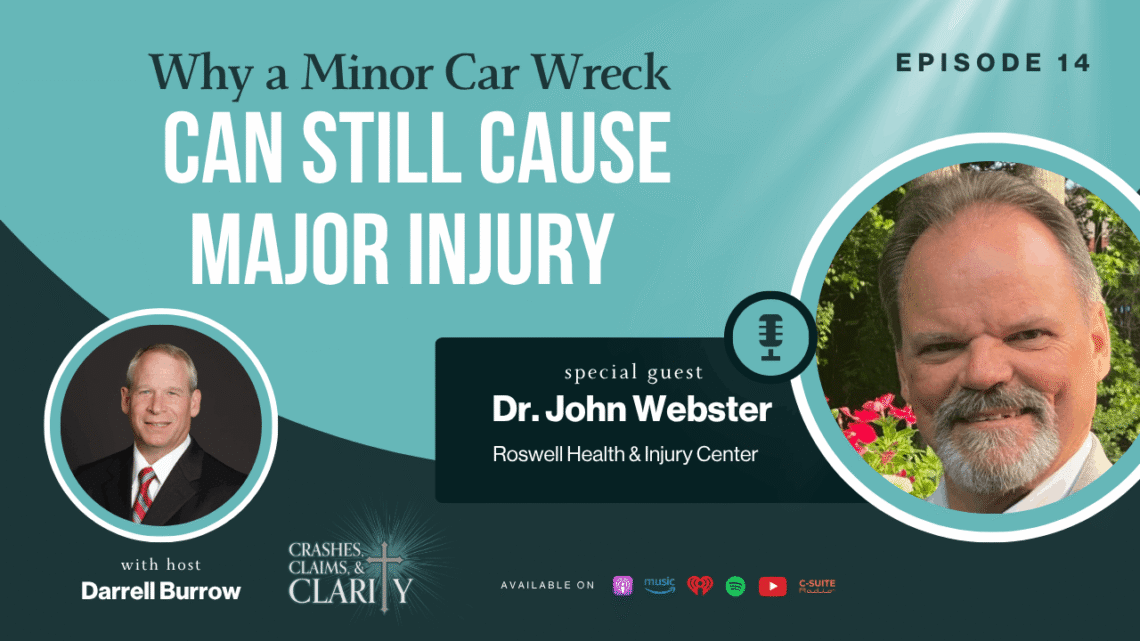
As a Duluth, GA car accident lawyer, Darrell Burrow has seen many cases where injuries from a seemingly minor collision became far more serious than anyone initially expected. The appearance of a vehicle after a crash does not always reflect the forces experienced by the human body, and symptoms can take days or even weeks to fully develop. In this episode of Crashes, Claims & Clarity, Darrell sits down with Dr. John Webster to discuss why low impact collisions can still cause significant injuries, the importance of early medical evaluation, and the steps accident victims can take to protect their health after a crash.
Why “Just a Minor Wreck” Can Lead to Major Problems Later
One of the most common phrases heard after a car accident is:
“It was just a minor wreck.”
The vehicle has a small dent.
The bumper barely shows damage.
Everyone walks away.
Life goes on.
At least that’s what many people believe.
But according to Dr. John Webster of Roswell Health & Injury Center, some of the most serious injuries occur in crashes that appear minor on the surface. After more than 40 years of practice and treating over 18,000 patients, Dr. Webster has seen firsthand how seemingly minor collisions can create lasting physical problems if left untreated.
In Episode 14 of Crashes, Claims & Clarity, host Darrell Burrow and Dr. Webster discuss what really happens to the body during a collision, why delayed symptoms are so common, and how accident victims can protect both their health and their future.
The Car May Not Look Damaged. Your Body Is a Different Story.
Modern vehicles are designed to absorb impact.
Bumpers.
Crumple zones.
Safety systems.
Advanced engineering.
While these features protect passengers, they can also create a false sense of security.
Dr. Webster explains that today’s vehicles can absorb significant impact without showing extensive visible damage. Unfortunately, the human body absorbs forces as well, and the body does not have the same protection systems built into it.
The result is that a vehicle may appear relatively undamaged while the occupants experience substantial stress on muscles, joints, ligaments, discs, and nerves.
That is why vehicle damage alone does not determine whether someone is injured.
Every Accident Creates a Different Injury Pattern
No two accidents are exactly alike.
The direction of impact matters.
Speed matters.
Seat position matters.
Whether the driver saw the collision coming matters.
Even where a person was looking at the moment of impact can affect the injuries sustained.
Dr. Webster explains that a rear-end collision creates very different forces than a side-impact crash.
A T-bone collision.
An angled impact.
A head-on collision.
Each mechanism affects the body differently.
That is why understanding the details of the accident helps healthcare providers identify injuries that may not be immediately obvious.
Why Symptoms Do Not Always Appear Immediately
Many accident victims leave the scene feeling relatively normal.
They exchange insurance information.
Talk to police officers.
Call family members.
Drive home.
Then, a day or two later, the symptoms begin.
Neck stiffness.
Headaches.
Shoulder pain.
Numbness.
Back pain.
Difficulty sleeping.
Dr. Webster explains that this delayed response is common because the body’s initial stress response often masks symptoms. The person may not realize the extent of their injuries until the body begins reacting to the trauma.
By the time symptoms appear, valuable treatment time may have already been lost.
The Injury You Cannot Always See
One topic Dr. Webster feels deserves more attention is traumatic brain injury.
Many people assume brain injuries require a visible head wound.
That is not necessarily true.
During a collision, the brain can move inside the skull as the body rapidly accelerates and decelerates. Even without a direct blow to the head, this movement can create injuries that affect memory, concentration, mood, sleep, and cognitive function.
Because these symptoms are often subtle, many accident victims do not realize they are experiencing a concussion or mild traumatic brain injury.
The symptoms may appear gradually and can easily be mistaken for stress or fatigue.
Scar Tissue Is Not Your Friend
One of the most important lessons from this episode is understanding how the body heals.
When injuries occur, the body begins repairing damaged tissue.
Unfortunately, healing is not always perfect.
Dr. Webster explains that untreated injuries often heal with scar tissue. While scar tissue is part of the body’s natural repair process, it lacks the flexibility and function of healthy tissue. Over time, this can lead to stiffness, restricted movement, pain, degeneration, and chronic problems.
Many people who ignore accident injuries discover months or years later that the pain never truly went away.
It simply evolved.
Why Early Evaluation Matters
One of the biggest mistakes accident victims make is assuming that no pain means no injury.
Dr. Webster strongly encourages anyone involved in a collision to undergo a thorough evaluation, even if symptoms seem minor. A proper examination can identify issues before they become long-term problems.
A comprehensive evaluation may include:
- Physical examination.
- Neurological testing.
- Range-of-motion assessments.
- X-rays.
- Advanced imaging referrals when necessary.
- Specialist consultations.
The goal is not to find problems.
The goal is to make sure problems are not missed.
Why Following the Treatment Plan Matters
Dr. Webster also discusses another challenge he sees frequently.
People start treatment.
They begin feeling better.
Then they stop.
Life gets busy.
Work demands increase.
Pain decreases.
Appointments are skipped.
The problem is that feeling better is not the same as being healed.
Ligaments, muscles, and connective tissues often require months to fully recover. Interrupting treatment too soon can increase the risk of chronic pain and incomplete healing.
In addition, treatment gaps can create questions if a personal injury claim becomes necessary.
Consistency benefits both recovery and documentation.
The Bottom Line
A minor-looking accident can create major injuries.
The amount of visible vehicle damage does not determine what happened inside the body.
Pain may not appear immediately.
Brain injuries can go unnoticed.
Scar tissue can create long-term problems.
And delayed treatment can complicate both healing and legal claims.
The safest approach is simple:
Get evaluated.
Follow the treatment plan.
Pay attention to your body.
And remember that the true impact of an accident is not always visible from the outside.
Listen to the Full Episode
Episode 14: What Really Happens to Your Body After a Car Accident?
About Crashes, Claims & Clarity
Hosted by Darrell Burrow, founder of Burrow & Associates, Crashes, Claims & Clarity helps accident victims understand the medical, legal, emotional, and financial challenges that often follow a serious injury. Through conversations with healthcare professionals, legal experts, and community leaders, the podcast provides practical guidance to help people recover and move forward with confidence.