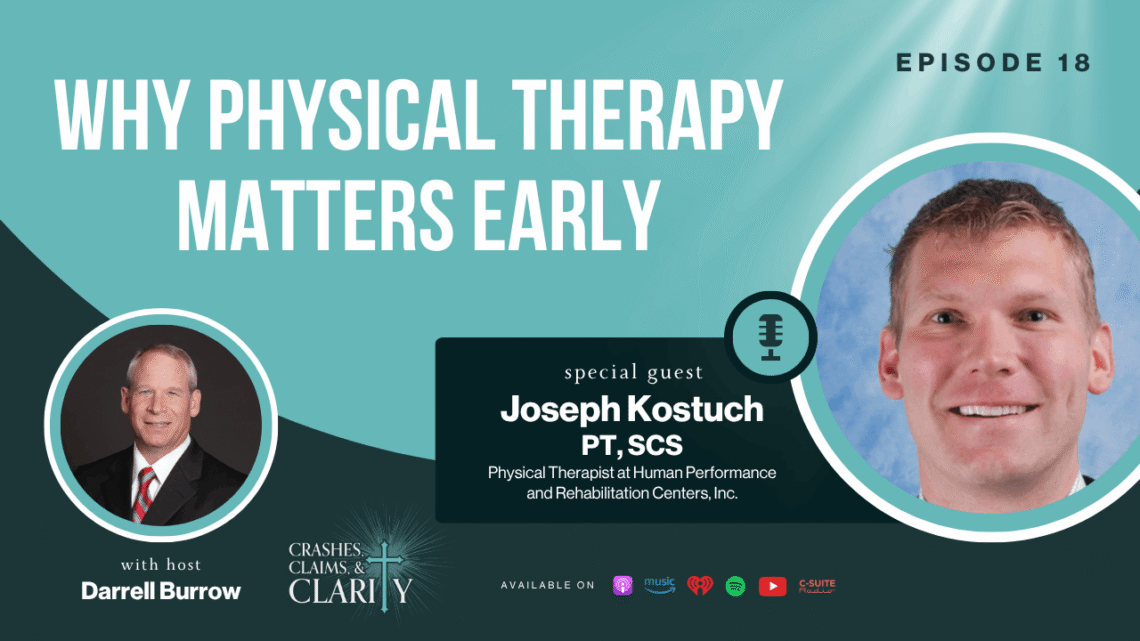
As a Duluth, GA motorcycle accident lawyer, Darrell Burrow has seen many injury victims underestimate the impact of a crash during the first few days after an accident. Symptoms can develop gradually, and what initially seems like minor soreness may later reveal a more significant injury requiring ongoing treatment and rehabilitation. In this episode of Crashes, Claims & Clarity, Darrell speaks with Joseph H. Kostuch of HPRC Physical Therapy about the recovery process, the importance of early intervention, and how physical therapy can help accident victims restore function, reduce pain, and support long term healing.
The First Few Days After an Accident Can Be Misleading
One of the biggest mistakes people make after a workplace injury or motor vehicle accident is assuming they know how serious their injuries are within the first day or two.
They feel sore.
They feel stiff.
They expect things to improve.
And sometimes they do.
But many injuries reveal themselves gradually, making those early days after an accident one of the most important periods in the recovery process.
In Episode 18 of Crashes, Claims & Clarity, attorney Darrell Burrow sits down with Joseph H. Kostuch of HPRC Physical Therapy to discuss what recovery really looks like after an injury, why movement matters, and how physical therapy can help accident victims avoid setbacks while building a stronger path toward recovery.
Why the First Week Can Fool You
After an accident, the body immediately enters a stress response.
Adrenaline increases.
Inflammation begins.
Pain patterns are often unclear.
Many people notice new symptoms emerging days after the initial event.
According to Joe, this is completely normal.
What hurts on day one may be different from what hurts on day seven. A shoulder that felt fine initially may become painful later. A back injury may not fully reveal itself until the body begins returning to normal activity.
That is why early evaluation is so important.
The first few days are often too soon to fully understand the extent of an injury.
Normal Soreness Versus Something More Serious
One of the most valuable roles physical therapists play is helping patients distinguish between expected soreness and more significant injuries.
After an accident, some discomfort is expected.
The body has experienced trauma.
Muscles tighten.
Joints become irritated.
Inflammation increases.
But physical therapists are trained to identify signs that suggest a more serious issue may be present.
Questions physical therapists help answer include:
- Is this pain coming from muscle soreness?
- Could there be a fracture?
- Is there a ligament injury?
- Could a joint have been dislocated?
- Is additional imaging needed?
- Should another medical specialist become involved?
Those distinctions can dramatically affect both treatment and recovery.
Movement Is Medicine
One of the central themes throughout the conversation is simple:
Keep moving.
Many injured people assume the best recovery strategy is complete rest.
While rest has a place, prolonged inactivity often creates new problems.
Stiffness increases.
Strength decreases.
Mobility declines.
Everyday tasks become more difficult.
Joe encourages patients to continue moving as much as their symptoms safely allow.
That may mean:
- Walking to the mailbox.
- Taking short walks around the neighborhood.
- Returning to modified work duties.
- Performing prescribed home exercises.
- Staying active within reasonable limits.
The goal is not pushing through severe pain.
The goal is preventing unnecessary loss of function.
The Importance of Early Intervention
One of the advantages available to many Georgia residents is direct access to physical therapy.
Under Georgia law, patients can often begin physical therapy treatment without first obtaining a physician referral for a limited period. This allows injured individuals to start the recovery process quickly while coordinating additional medical care when necessary.
Early intervention can help:
- Reduce pain.
- Improve mobility.
- Prevent compensation injuries.
- Identify red flags.
- Create a treatment plan.
- Establish documentation early.
When recovery begins sooner, long term outcomes are often improved.
Recovery Is More Than Ice and Heat
Many people think physical therapy consists primarily of ice packs and heating pads.
While those tools can be helpful, modern physical therapy includes far more.
Depending on the injury, treatment may involve:
- Therapeutic exercises.
- Range of motion training.
- Manual therapy.
- Trigger point treatment.
- Dry needling.
- Ultrasound therapy.
- Electrical stimulation.
- Functional movement training.
Each treatment plan is customized to the patient’s specific needs and injury patterns.
Why Home Exercises Matter
Physical therapy does not stop when a patient leaves the clinic.
In fact, some of the most important recovery work happens at home.
Joe explains that patients are often provided with customized exercise programs and educational tools that allow them to continue improving between appointments.
The patients who consistently follow their home programs often experience:
- Faster recovery.
- Better mobility.
- Improved strength.
- Reduced pain.
- Better long term outcomes.
Recovery is a partnership between the therapist and the patient.
Documentation Protects Everyone
As Darrell points out during the interview, documentation plays an important role in accident-related cases.
Physical therapists track progress carefully.
Pain levels.
Mobility measurements.
Strength improvements.
Functional abilities.
Outcome scores.
All of these benchmarks create an objective record of recovery.
That documentation benefits patients medically and can also become valuable when insurance companies, employers, or attorneys are reviewing the progression of an injury claim.
A well-documented recovery tells the complete story.
Not Every Symptom Appears Immediately
One issue that frustrates many accident victims is the appearance of new symptoms weeks after an accident.
Insurance companies sometimes question these delayed complaints.
Joe explains why delayed symptoms are common.
As people return to work, exercise, and daily life, they often discover injuries that were initially masked by the body’s early trauma response.
The fact that a symptom appears later does not automatically mean it is unrelated to the accident.
It simply means the recovery process is continuing to reveal information.
How Long Does Recovery Take?
Every injury is different.
Every person is different.
But Joe notes that many soft tissue injuries require significantly more time than people expect.
Even relatively straightforward injuries may require six to eight weeks of treatment and recovery. More significant injuries can take much longer.
Patience becomes an important part of healing.
Recovery is rarely instant.
The Bottom Line
The first few days after an accident can be deceptive.
Symptoms change.
Pain evolves.
New injuries may become apparent.
That is why early evaluation, consistent movement, and proper documentation are so important.
Physical therapy plays a critical role in helping accident victims understand what is happening inside their bodies while creating a roadmap toward recovery.
Because the sooner recovery begins, the better the chances of returning to normal life.
Listen to the Full Episode
Episode 18: Why Physical Therapy Matters Early After an Injury
About Crashes, Claims & Clarity
Hosted by Darrell Burrow, founder of Burrow & Associates, Crashes, Claims & Clarity helps listeners better understand the legal, medical, financial, and emotional challenges that often follow serious injuries. Through conversations with attorneys, healthcare providers, and recovery experts, the podcast delivers practical guidance to help people navigate the road ahead.