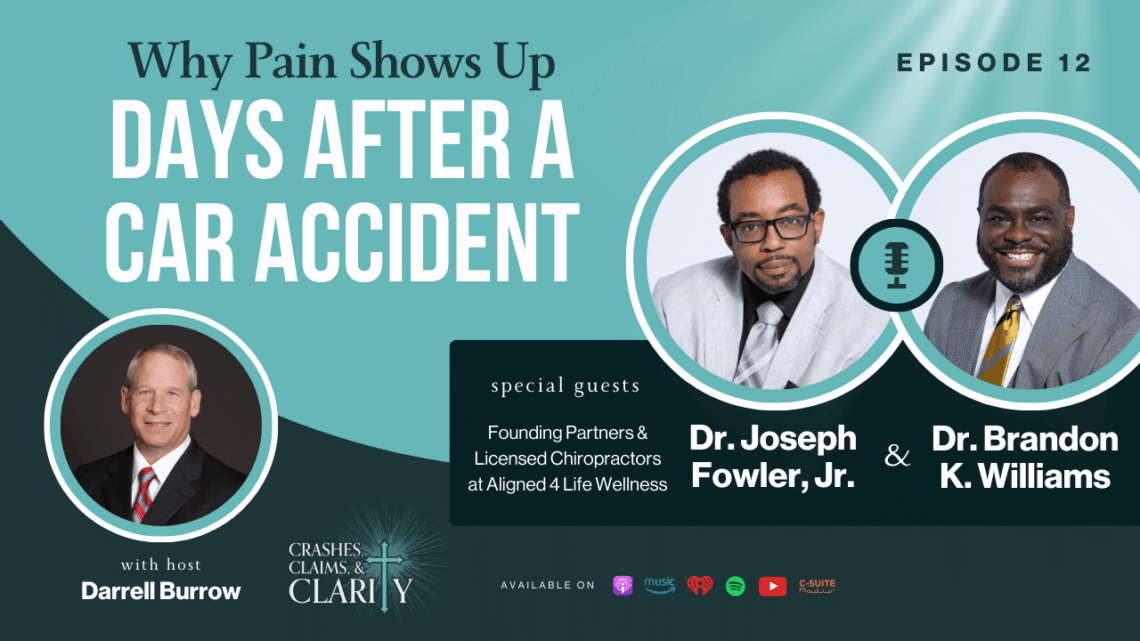
As an Athens, GA car accident lawyer, Darrell Burrow regularly works with individuals who initially believed they were uninjured after a collision, only to experience significant symptoms days later. Many accident related injuries do not appear immediately, making it easy for victims to underestimate the impact a crash may have on their health and daily lives. In this episode of Crashes, Claims & Clarity, Darrell speaks with Dr. Brandon Williams and Dr. Joseph Fowler Jr. about why delayed symptoms are so common after car accidents, the importance of prompt medical evaluation, and the steps accident victims can take to support a healthier recovery.
The Hidden Injuries That Many Accident Victims Never See Coming
One of the most common statements healthcare providers hear after a car accident is surprisingly simple:
“I felt fine at first.”
Many accident victims walk away from a collision believing they escaped injury.
They exchange information.
They call family members.
They speak with police officers.
They drive home.
And then a day or two later, everything changes.
The neck begins to stiffen.
The headaches appear.
The lower back starts aching.
Sleep becomes difficult.
Simple movements suddenly hurt.
In Episode 12 of Crashes, Claims & Clarity, host Darrell Burrow sits down with Dr. Brandon Williams and Dr. Joseph Fowler Jr., co-founders of Aligned for Life Wellness Clinic, to explain why accident injuries often appear days after a collision and why early evaluation is so important.
Why You May Not Feel Pain Right Away
One of the biggest misconceptions about car accidents is the belief that serious injuries always hurt immediately.
According to Dr. Williams, that simply is not true.
After a collision, the body releases adrenaline and other stress hormones that help us respond to danger. These chemicals can temporarily mask pain and make people feel much better than they actually are.
In the moments after an accident, your body is focused on survival.
It is not focused on helping you recognize every injury.
As those adrenaline levels begin to decline over the next several hours or days, symptoms often become more noticeable.
That is when many people discover they were injured after all.
Your Vehicle Absorbs Impact. So Does Your Body.
Modern vehicles are designed to protect passengers.
Crumple zones.
Airbags.
Seat belts.
Advanced safety systems.
All of these technologies help reduce injury.
But there is an important reality many people overlook.
The force generated during a collision has to go somewhere.
As Dr. Fowler explains, energy is transferred during a crash. While the vehicle absorbs much of the impact, the body often absorbs significant force as well.
That force can affect muscles, ligaments, joints, discs, nerves, and even the brain.
Some injuries become obvious immediately.
Others develop gradually as inflammation increases.
Common Injuries That Often Appear Later
Many accident victims expect dramatic injuries.
Broken bones.
Large bruises.
Visible wounds.
The reality is that many of the most common accident injuries are soft tissue injuries that may take time to fully reveal themselves.
Dr. Williams and Dr. Fowler frequently see:
- Neck pain and whiplash.
- Headaches.
- Mid-back pain.
- Lower back pain.
- Shoulder injuries from seat belts.
- Knee injuries.
- Sprained ankles.
- Numbness and tingling.
- Muscle spasms.
- Limited range of motion.
Because these symptoms often emerge gradually, many people delay treatment when they should be seeking evaluation.
Concussions Are Not Just Football Injuries
For years, most people associated concussions with sports.
Today, healthcare providers know that car accidents are another major source of traumatic brain injuries.
Even when there is no direct blow to the head, the rapid acceleration and deceleration of a collision can cause the brain to move inside the skull.
Symptoms may include:
- Headaches.
- Dizziness.
- Brain fog.
- Memory problems.
- Difficulty concentrating.
- Sleep disturbances.
- Sensitivity to light.
- Emotional changes.
Because these symptoms are sometimes subtle, accident victims may not realize they are experiencing a concussion or traumatic brain injury.
The Emotional Side of Recovery
Physical injuries are only part of the recovery process.
Many accident victims experience emotional trauma as well.
Fear of driving.
Nightmares.
Anxiety.
Panic attacks.
Difficulty sleeping.
Flashbacks.
The doctors explain that these emotional symptoms are common and should be taken seriously. In many cases, patients benefit from referrals to mental health professionals who specialize in trauma recovery.
Healing is not just about fixing the body.
It is also about addressing the impact an accident can have on the mind.
Why Early Evaluation Matters
One of the strongest messages from this episode is simple:
Get checked out.
Even if you think you are fine.
Even if the accident seems minor.
Even if the vehicle damage appears minimal.
A comprehensive evaluation can identify injuries before they become larger problems. X-rays, orthopedic testing, neurological assessments, and advanced imaging referrals when necessary help ensure important injuries are not overlooked.
The earlier injuries are identified, the sooner treatment can begin.
The Four Foundations of Recovery
The doctors also discuss the principles they encourage patients to follow both before and after injuries occur.
Proper Care
Address problems early and work with qualified healthcare professionals.
Proper Rest
Sleep is when the body repairs and recovers. Consistent, quality rest plays a critical role in healing.
Proper Exercise
Movement helps maintain strength, flexibility, and overall health.
Proper Nutrition
The body performs best when it receives the nutrients it needs to recover and function optimally.
These principles support recovery after an accident and help prepare the body for life’s unexpected challenges.
The Bottom Line
Just because pain does not appear immediately does not mean an injury does not exist.
Many accident injuries develop over time as adrenaline fades and inflammation increases.
Ignoring symptoms or delaying evaluation can make recovery more difficult and may allow injuries to worsen.
If you have been involved in a collision, listen to your body.
Pay attention to new symptoms.
Seek professional evaluation.
And remember that some of the most significant injuries are the ones that take a few days to reveal themselves.
Listen to the Full Episode
Episode 012: Why Pain Shows Up Days After a Car Accident
About Crashes, Claims & Clarity
Hosted by Darrell Burrow, founder of Burrow & Associates, Crashes, Claims & Clarity helps accident victims understand the legal, medical, financial, and emotional challenges that often follow a serious injury. Through conversations with attorneys, healthcare professionals, and experts, the podcast provides practical information designed to help people recover with confidence.